JustVibe Review: It Builds Apps From Search – Can It Finish?
JustVibe turns a search request into an interactive app. Instead of returning a normal answer, it tries to build something you can actually use inside the browser.
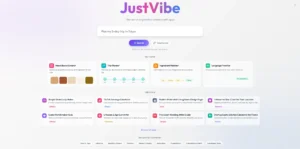
That could be a trip planner, calculator, language-practice tool, mood-board creator, finance app, or another small utility. The platform also provides a public library of ready-made apps, so users can open an existing tool without creating anything from scratch.
As of July 13, 2026, JustVibe was free to use. I could search and open apps without adding payment details. An account was not required for basic use, although saving generated projects may involve its library system.
I began with one of its ready-made tools: Farsi Practice: Ordering Coffee.

The app looked more complete than a basic AI chat. A mission briefing explained the goal, while a side panel displayed useful Persian vocabulary with English meanings and pronunciation support. The main area used a chat-style layout where I could type responses and receive corrections.
It also included controls for hints, suggested replies, audio, saving, sharing, and editing. That gave the lesson a proper app-like feeling instead of presenting everything as plain text.
My first response was “salam.” JustVibe converted it into the correct Persian script, “سلام.” It later corrected another response and suggested a cleaner sentence.
The feedback section showed the original answer and the improved version, which made each correction easy to compare.
However, the scenario ended after only two turns.
That was far too early for the stated task. The mission required ordering coffee and asking for the price, yet the practice stopped before a meaningful conversation could develop.
The final summary showed a fluency score of 50, two completed turns, a list of mistakes, and the full conversation history. The reporting system looked useful, but the score did not feel well supported. Two short replies are not enough to measure someone’s fluency with much confidence.
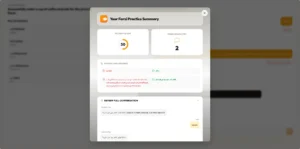
The ready-made app proved that JustVibe can create a clean and comfortable experience for simple tasks. The layout was organized, the controls were easy to understand, and the correction system worked.
The next test was designed to push the platform much harder.
I asked JustVibe to create an advanced English-practice app for a Bengali-speaking learner. It needed five connected stages involving a British job interviewer, an American HR manager, a Japanese colleague, an angry customer, and a final emergency meeting.
The app was also instructed to remember details across every stage. It needed to track salary expectations, work experience, dates, payment information, customer demands, weaknesses, and promised solutions.
Each answer had to receive grammar, tone, vocabulary, fluency, and task-completion scores. The app also needed corrections, Bengali explanations, pronunciation help, adaptive follow-up questions, difficulty controls, and a final seven-day improvement plan.
This was a serious request, but it matched the platform’s main idea: turning a detailed need into a working interactive app.
The first attempt ran for more than three minutes and reached around 30% progress. Then JustVibe stopped and displayed an error saying it could not finish building the app.

I tried the same request again.
The second attempt went much further. JustVibe prepared the visual system and showed several planned components, including a scenario and memory dashboard, chat interface, and real-time feedback panel.
After around eight minutes, progress reached 94%.
Then it stopped moving.
I continued waiting, but after 32 minutes and 49 seconds, the build was still sitting at 94%. There was no completed app and no final error message. The interface claimed the project had been saved to the library, but the unfinished result could not be tested or used.
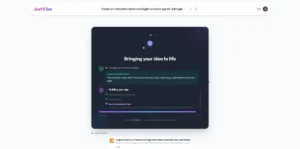
This created two possible endings for a heavy request. JustVibe may surrender early with an error, or it may keep the user waiting near the finish line without explaining whether the build is still active.
The second outcome was more frustrating. A quick failure wastes a few minutes. A frozen build can quietly consume half an hour while giving the impression that completion is only moments away.
JustVibe works best when the request is lightweight. Its existing apps can look polished, and the browser-based experience is easy to explore. The idea of receiving an interactive tool instead of another long AI response is genuinely useful.
However, complex app generation is not dependable enough yet. Requests involving multiple stages, memory, adaptive logic, and several connected features may exceed what the platform can reliably complete.
The platform can give simple ideas a convincing visual form. The real question is whether it can finish the app once the idea becomes demanding. In my hardest test, Optizeno answer was no.
Pros
- Free to explore
- No payment details required
- Clean interactive layouts
- Large ready-made app library
- Save and share controls included
Cons
- Complex app generation is unreliable
- Builds freeze near completion
- Failure messages lack useful details
- Ready-made lessons end too early
- Scoring lacks enough evidence
- Prompts are limited to 2,000 characters
- Heavy requests waste significant time