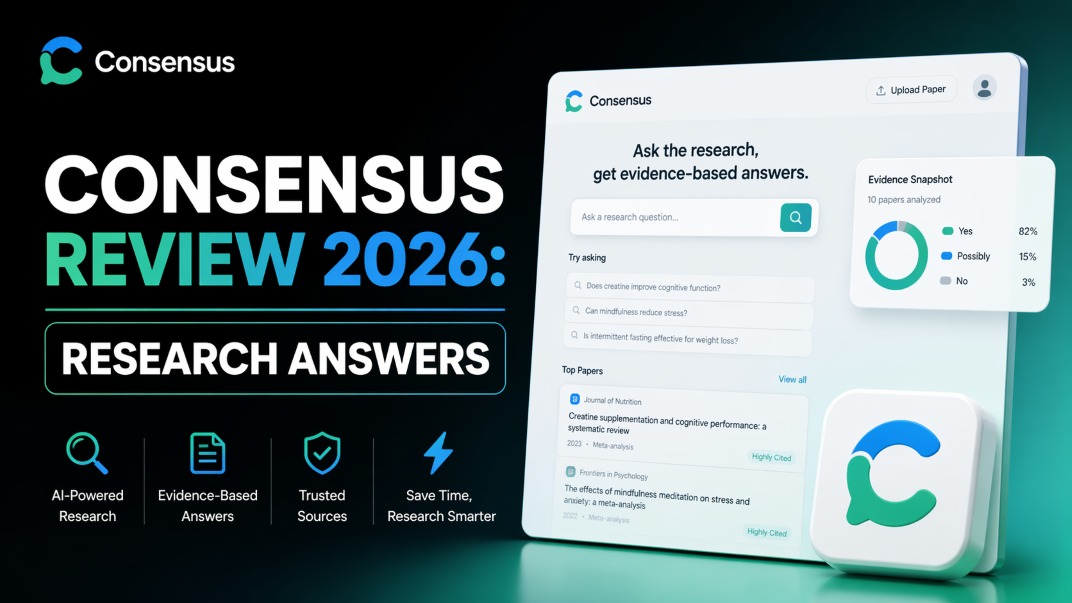
Consensus Review 2026: Research Answers
I tested Consensus to see whether it truly helps people find evidence-based answers faster, and I’ll say this clearly: if you often search Google for health, business, psychology, science, education, or academic questions, Consensus feels like a smarter and cleaner alternative.
Instead of giving random blog posts or opinion-heavy articles, Consensus searches peer-reviewed research papers and turns findings into readable answers. That makes it one of the most practical AI tools I’ve tested for people who care about facts.
In 2026, misinformation is still everywhere online. Many search results are built for clicks, not truth. Consensus solves that problem by focusing on published studies and academic evidence. For students, writers, researchers, marketers, founders, journalists, and curious professionals, that is a major advantage.
What Consensus Actually Does
Consensus is an AI-powered academic search engine.
You type a question such as:
- Does creatine improve memory?
- Does remote work increase productivity?
- Is intermittent fasting effective for weight loss?
- Does journaling reduce stress?
Then the platform scans research papers and summarizes what studies show.
This is the key difference.
Most AI chatbots generate answers from mixed internet data. Consensus is built to prioritize scholarly evidence. It does not feel like a general chatbot. It feels like a research assistant designed for serious questions.
My Experience Using It
When I tested Consensus, the first thing I liked was how simple the interface is.
There is no clutter. You ask a question in plain English. The results appear with summaries, linked studies, and clear signals around findings. You do not need advanced academic search skills.
That matters because many people avoid tools like Google Scholar due to poor usability. Consensus feels modern and beginner-friendly.
I also liked that it saves time.
Normally, to answer one question properly, you might need to open ten studies, read abstracts, compare conclusions, and check dates. Consensus compresses that process into minutes.
Why Consensus Stands Out in 2026
Many AI tools claim to help with research. Few are genuinely useful.
Consensus stands out because it solves a real pain point:
Finding trustworthy information quickly.
This is valuable for:
- Students writing assignments
- Bloggers creating evidence-backed content
- Coaches checking health claims
- Startup founders researching trends
- Journalists fact-checking ideas
- SEO writers needing credible support points
- Professionals making smarter decisions
For Optizeno readers looking for the best AI tool review platform recommendations, Consensus deserves attention because it offers something practical, not just hype.
Smart Summaries Without Heavy Reading
One feature I found useful is how it summarizes findings in plain language.
Academic papers are often dense, technical, and slow to read. Consensus removes friction by explaining results in readable terms.
That does not replace reading the source paper, but it helps you decide what is worth opening first.
For busy users, that alone is a huge productivity gain.
Helpful for Content Creation Too
Many people overlook this.
Consensus is excellent for writers.
If you publish blogs, newsletters, YouTube scripts, or reports, it helps you validate claims before publishing. Instead of saying “studies suggest,” you can actually locate relevant evidence.
That increases trust and content quality.
In a crowded SEO market, trust matters more every year.
Pricing (April 2026)
At the time of writing, Consensus appears to offer a freemium model.
Typical access includes:
- Free searches with usage limits
- AI summaries
- Basic research tools
Paid plans may unlock:
- Higher search volume
- Faster access
- Premium AI features
- Expanded workflows
- Better productivity tools for professionals or teams
Pricing can change over time, so check the official website for the latest plans.
What I Personally Liked
After testing it, these were the strongest benefits:
1. Clean user experience
Easy for non-academic users.
2. Fast evidence discovery
You get useful direction quickly.
3. Better than generic search for factual topics
Especially health, psychology, and science.
4. Great for professionals
Writers, consultants, educators, and founders can use it daily.
5. Reduces weak content
Helps you publish smarter material.
Where It Still Has Limits
No tool is perfect.
Consensus depends on available published studies. If a topic is very new, niche, or poorly researched, results may be limited.
Also, summaries are useful, but serious users should still open original studies before making big decisions.
It is excellent for direction. It should not replace expert judgment.
Another limitation is that some casual users may expect entertainment-style chatbot conversations. That is not the main purpose here.
Who Should Use Consensus?
I would recommend it to:
- University students
- Researchers
- Journalists
- Health writers
- Business analysts
- SEO professionals
- Curious learners
- Coaches needing evidence-backed content
If your work depends on quality information, this tool can easily justify a spot in your workflow.
Final Verdict
Consensus is one of the most genuinely useful AI tools I tested in the research category.
It avoids fluff. It focuses on facts.
That alone makes it valuable in 2026.
If you are tired of weak search results, exaggerated claims, and endless content farms, Consensus offers a better path.
It is not just another AI chatbot. It is a focused evidence engine.
For people who value trustworthy answers, that is powerful.
Pros
- Searches peer-reviewed research papers
- Easy plain-English interface
- Strong summaries that save time
- Great for writers and students
- Better than generic search for factual topics
Cons
- Limited on very new or niche topics
- Full papers still need manual review
- Free plan may have usage caps
- Not built for casual chatbot entertainment
- Some advanced users may want deeper filters